Showing posts with label sustainable. Show all posts

25 February 2014

How to Write a Business Plan

credit to http://www.startupdonut.co.uk/

Writing a business plan

Many potential start-up businesses are daunted by the prospect of writing a business plan. But it is not a difficult process - and a good business plan focuses the mind as well as helping to secure finance and support.

The business plan will clarify your business idea and define your long-term objectives. It provides a blueprint for running the business and a series of benchmarks to check your progress against. It is also vital for convincing your bank - and possibly key customers and suppliers - to support you.

This briefing explains:
  • What information to include.
  • How to present your financial forecasts.

1 Executive summary

The executive summary outlines your business proposal. Although it is the last section to be written, it goes on the first page of the business plan. It will be read by people unfamiliar with your business, so avoid jargon.

1.1 The executive summary highlights the most important points and shouldsum up six areas.
  • Your product or service and its advantages.
  • Your opportunity in the market.
  • Your management team.
  • Your track record to date.
  • Financial projections.
  • Funding requirements and expected returns.

1.2 When deciding whether to back a start-up, bank managers and investors often make provisional judgements based on the executive summary.
The main body of the business plan is then read to confirm the initial decision. The appendices at the back of the plan carry detailed information to support the main text.


2 The business

2.1 Explain the background to your business idea, including:
  • The length of time you have been developing the business idea in its present form.
  • Work carried out to date.
  • Any related experience you have.
  • The proposed ownership structure of the business.

2.2 Explain, in plain English, what your product or service is. Make it clear how:
  • it will stand out as different from other products or services
  • your customers will gain through buying your product or service
  • the business can be developed to meet customers' changing needs in the future

It is important to cover any disadvantages or weak points you feel the business may have. Be frank about these - it inspires confidence.

2.3 Explain any key features of the industry (eg special regulations, effective cartels or major changes in technology).


3 Markets and competitors

3.1 Focus on the segments of the market you plan to target - for example, local customers or a particular age group.
  • Indicate how large each market segment is and whether it is growing or declining.
  • Illustrate the important trends - and the reasons behind them.
  • Outline the key characteristics of buyers in each segment (eg age, sex or income).
  • Mention customers you have already lined up and any sales you have already achieved.

3.2 What are the competing products and who supplies them?
  • List the advantages and disadvantages of all your competitors and their products.
  • Explain why people will desert established competitors and buy from you instead.
  • Show you understand your competitors' reaction to losing business and demonstrate how you will respond to it.

Unless there is a viable market and you know how you are going to beat the competition, your business will be vulnerable.

You must show you have done the market research needed to justify what you say in the plan.


4 Sales and marketing

This section is crucial. It often gives a good indication of the business' chances of success.

4.1 How will your product or service meet your customers' specific needs?

4.2 How will you position your product?

  • This is where you show how your price, quality, response time and after-sales service will compare with competitors.
  • Quote minimum order figures, if appropriate.

4.3 How will you sell to customers?

  • For example, by phone, through your website, face-to-face or through an agent.
  • Show how long you predict each sale will take. Many new businesses underestimate the time involved in winning each order. In year one you may spend up to 80 per cent of your time making contacts and selling.
  • Will you be able to make repeat sales? If not, it will be hard to build up volume.

4.4 Who will your first customers be?

  • Show which customers have expressed an interest or promised to buy from you and the sales they represent.
  • How will you identify potential customers?
Unless you can demonstrate that you have a clearly defined pool of potential customers, starting your business is likely to be a struggle.

4.5 How will you promote your product? For example, using advertising, PR, direct mail or via email and a website.

4.6 What contribution to profit will each part of your business make?

  • Most businesses need more than one product, more than one type of customer and more than one distribution channel.
  • Look at each in turn. Examine your likely sales, gross profit margins and costs.
  • Identify where you expect to make your profits and where there may be scope to increase either margins or sales.
Services and intangible products (eg computer software) are more difficult to market. Start-ups in these areas must pay special attention to marketing in their business plans.


5 Management

People reading the business plan need to be given an idea of why they should have faith in the management of your start-up.

5.1 Outline the management skills within your team.
  • Define each management role and who will fill it.
  • Show your strengths and outline how you will cope with any weaknesses.
  • Describe the background and experience of each team member.
  • Clarify how you intend to cover the key areas of production, sales, marketing, finance and administration.
  • Management information systems and procedures should be outlined. For example, management accounts, sales, stock control and quality control.
  • Show how many 'mentors' and other supporters you will have access to.

5.2 How committed are you?
Banks and any other potential investors will want to be sure you are committed to the business. Show how much time and money each of the management team will contribute, and what your salaries and benefits will be.


6 Operations

Explain what facilities the business will have and how it will deliver the product or service to the customer.

6.1 Show the pros and cons of the location.

6.2 Indicate the facilities you will need to start (eg equipment and machinery). Some start-up businesses only need a desk and a phone.
Consider any potential limits to production capacity.

If you are going to manufacture or distribute products, show how and where you are going to warehouse them and for how long.

6.3 Provide a list of employee roles you need to fill and the skills required to fill them.

6.4 Show how you selected your suppliers.

Keep it real

Sales forecasts produced for start-up businesses are often over-optimistic. Here are some important reality checks.
  • How soon can you start selling?
  • Will potential customers hold off for a year before they take you seriously and place an order?
  • How often will you be able to sell?
  • How many days can you spend selling?
  • How long will each lead take to line up?
  • What percentage of leads will turn into sales?
  • How much will you be able to sell?
  • What will the average sale value be?
  • Will most people give repeat orders, or must you find new customers each time?
  • How long after a sale will it be before you can collect payment?
  • How much income can you realistically expect each month?


7 Financial forecasts

Your financial forecasts translate what you have already said about your business into numbers.

7.1 A realistic sales forecast forms the basis for all your other figures.
Break the total sales figure down into its components (eg different types of products or sales to different types of buyer).

7.2 Your cashflow forecast shows how much money you expect to be flowing into and out of your bank account and when. You must show that your business will have access to enough money to survive.

  • Demonstrate that you have considered the key factors affecting cashflow - eg level and timing of sales revenue, wages.
  • Show when there will be more money coming in than going out ('cash-positive').

7.3 Your profit and loss (P&L) forecast gives a clear indication of how the business will move forward. Summarize the annual P & L forecast for each of the first two or three years of trading.

7.4 If you are launching a larger start-up, you will also need projected balance sheets.

These will show you the financial state of your business on day one and at year end, perhaps for the first two or three years.

7.5 Do not get too protective about your forecasts. You may need to revise them.

For every forecast, list all your key assumptions (eg prices, sales volume, timing). Small business advisers at banks and your local business support organisation will often help you put together your forecasts free of charge.


8 Financial requirements

The cashflow forecast will show how much finance the business needs. Your assessment of the risks will determine whether or not you need to arrange contingency financing.

8.1 Say how much finance you will want, when and in what forms.

For example, you might want a fixed-interest loan and an overdraft facility.

8.2 State what the finance will be used for.
Show how much will be for buying equipment and how much for working capital (financing stock and debtors).

8.3 Confirm that you will be able to afford it.


9 Assessing the risks

9.1 Look at the business plan and isolate areas where something could go wrong (eg if your main supplier closes down).
What you would do if it actually happens?

9.2 Consider a range of what-if scenarios (eg what happens to your cashflow if sales are 20 per cent lower or 15 per cent higher than forecast). If there are serious risks:

  • you can arrange contingency funding to cover the finance you may need
  • you may decide that the business is too risky and abandon the whole project.
Assessing risk will help you minimise problems and help build up your credibility with any investor or bank.


10Appendices

10.1 Detailed financial forecasts (monthly sales, monthly cashflow, P&L) should usually be put in an appendix.
Include a detailed list of assumptions.

For example, the profit margin on each product, debtor collection period, creditor payment period, stock turn, interest and exchange rates, equipment purchases.

10.2 You may want to give other relevant information.
  • Detailed CVs of key personnel (essential if you are seeking outside funding).
  • Market research data.
  • Product literature or technical specs.
  • Names of target customers.
  • A list of external data sources used in your research will add credibility to the information.


11 Presenting the plan

The more solid information you can gather for your own use, the better the business plan will be. But a banker or other outsider will not have time to read through all the details.

11.1 Keep your business plan short.
Most business plans are too long. Focus on what the reader needs to know.

11.2 Make it professional.

  • Put a cover on the business plan and give it a title.
  • Include a contents page.

11.3 Test it.

  • Re-read it yourself. Would reading your plan give an outsider a good feel for your business and a grasp of the key issues?
  • Show the plan to friends and expert advisers and ask them for comments.

08 October 2013

Different Types of Aquaponics Systems


There are three different types of aquaponics systems that have been developed for use by home gardeners and commercial enterprises. These are media based, NFT and Deep Flow or Raft systems and here is a description of each one.


Media-based: also known as the gravel bed system, the media-based aquaponics system is the simplest type to set up and can be used on a small or large scale. This is why it is the type most commonly used by backyard aquaponics enthusiasts. Containers are filled with small rocks, usually expanded clay pebbles which are porous to absorb water and air, and then seedlings are planted directly into these. Water from the fish tank is circulated through the container to allow the plants to access the nutrients. The rocks act as a biological filter as well as a solids filter, eliminating the need for extra equipment.

You can also use special netted growing pots for your seeds or seedlings. You fill these with perlite, coir, peat moss or the clay pebbles and plant into them. These pots are then placed into a larger container which has been filled with the expanding clay pebbles, making sure the netted sides are covered by the media. Media-based aquaponics systems hold plants firmly and so are ideal for growing fruiting plants.

There are two different ways this type of aquaponics system can be operated. The first method pumps a continuous flow of water through the media bed from the fish tank and back into the tank. The second is a process called flood and drain or ebb and flow, where water is pumped into the bed to a depth of about 10 to 12 inches (20 to 30 cms) and then drained away. A timer controls the flooding and draining sequence.


NFT system: or Nutrient Film Technique is a common method used in hydroponics that is best suited to a large-scale aquaponics production. This is because of the expense of setting up the system of PVC pipes and mechanical filtration needed to operate the system. Because there is not the surface area exposed to the air, as in the media-based system, a biological filter is needed to allow the beneficial bacteria to develop and convert the fish wastes into plant nutrients. Solids filtration is also needed to deal with the solids in the fish waste; this is usually set up in a separate tank through which the water passes before going through the plant pipes.

In the NFT system, plants are held in netted growing pots which are suspended through holes cut in the pipe. A thin film of nutrient-rich water is run along the bottom of enclosed gutters so that the roots can reach it. It is really only suited to plants that have a small root systems, such as leafy green vegetables.


Deep Flow: also called Deep Water Culture (DWC) or the Raft system, this is another commonly-used method in hydroponics. This system involves the use of a foam ‘raft’ that floats on top of the water. It is a popular choice for both commercial and backyard aquaponics because it is relatively cheap to set up and operate.

A container or channel is used to hold the water as it is pumped through from the fish tank, after it has been filtered to remove any solid waste. Plants are held in holes made in the raft, so their roots dangle down into the water. This method uses high volumes of water which provides stable water temperatures for the plants and fish. It is the method most often used in commercial aquaponics operations because of the ease with which the plants can be tended and harvested. Again, it is better suited to growing herbs and leafy green vegetables than plants with bigger root systems and fruiting varieties.

This type of system can easily be adapted for home garden use by simply floating a styrofoam tray on top of a fish tank. Just cut holes in the tray and suspend the plants, or plants in netting pots, through the holes so the roots are in contact with the water. Choose fish varieties that are not voracious plant eaters to avoid having plants’ roots eaten away.

Now that you understand how each of the 3 types of aquaponics systems operates, you will be in a better position to decide which one suits you the best. Whichever method you choose, it is best to start small so you can gradually build your expertise and experience before setting up a large system.


24 June 2013

Permaculture + Aquaponics = Self Sustaining


By bringing Permaculture Design principles and practices into Aquaponics, we are closing many loops, inefficiencies, and energy drains that exist in more conventional systems, as well as integrating the system appropriately into the larger landscapes and ecologies it is a part of, making it a much more holistic and sustainable enterprise. 


Closed-Loop Aquaponics focuses on designing aquaponics systems that that produce as much of the system’s needs (water, energy, fish, feed, heat, gas, etc.) on-site and within the system itself as possible. 


Products of the systems can include; solar electricity, solar heated air, solar heated water, fish, prawns, vegetables, fruit, aquatic plants, algae, minnows, snails, worms, dry and liquid fertilizers, methane gas, and more. By using the Permaculture Design process, we learn to design systems appropriate to diverse climates and unique ecological niches to meet various needs, dreams, and desires.

17 June 2013

Aquaponics' Advantages - Commercially

credit to http://centerforaquaponics.com

Aquaponic systems possess many attractive commercial applications, as well as environmental and human health benefits, making them ideal for future use in developing regions of the world. Quantifiable results include:


• Additive water conservation benefits of recirculating aquaculture and hydroponics combined into an integrated waste free system. With uncertainty regarding water supplies and the population carrying capacity of arid regions of the world, water conservation practices may result in aquaponics replacing more traditional forms of food production. Additionally, the plant and microbial remediation of the fish effluent (waste) prevents environmental contamination (eutrophication) common with many forms of aquaculture.


• A controlled-environment greenhouse operation greatly increases the reliability of production while reducing the risk of environmental degradation such as non-native species introduction which is prevalent with other forms of agriculture. Through the prevention of greenhouse pest outbreaks the need for synthetic pesticides has been eliminated.


• Combining aquaculture and hydroponics technologies has demonstrated the potential to exceed the productivity and profitability of independently operated systems for a given resource constraint (land, water, capital).


• Unlike warm blooded food stocks, cultured aquatic species are not considered high probability vectors of zoonotic diseases to humans. They require fewer inputs (feed and time) than other livestock. The feed conversion ratio and carbon footprint for farmed fish is significantly less than other sources for animal protein.


• The technologies employed to run an aquaponics operation can be primitive and produced from a large range of readily available (post-consumer) materials. This lowers the overall environmental footprint of the design and broadens the availability of the technology to poorer regions of the world.

08 June 2013

Aquaponics is Organic


Organic Grown Food
http://www.epa.gov/agriculture/torg.html

"Organically grown" food is food grown and processed using no synthetic fertilizers or pesticides. Pesticides derived from natural sources (such as biological pesticides) may be used in producing organically grown food.


Organic Farming
http://en.wikipedia.org/wiki/Organic_farming

Organic farming is a form of agriculture that relies on techniques such as crop rotation, green manure, compost and biological pest control. Organic farming uses fertilizers and pesticides but excludes or strictly limits the use of manufactured (synthetic) fertilizers, pesticides (which include herbicides, insecticides and fungicides), plant growth regulators such as hormones, livestock antibiotics, food additives, genetically modified organisms, human sewage sludge, and nanomaterials.

Organic agricultural methods are internationally regulated and legally enforced by many nations, based in large part on the standards set by the International Federation of Organic Agriculture Movements (IFOAM), an international umbrella organization for organic farming organizations established in 1972. IFOAM defines the overarching goal of organic farming as:

"Organic agriculture is a production system that sustains the health of soils, ecosystems and people. It relies on ecological processes, biodiversity and cycles adapted to local conditions, rather than the use of inputs with adverse effects. Organic agriculture combines tradition, innovation and science to benefit the shared environment and promote fair relationships and a good quality of life for all involved..."
—International Federation of Organic Agriculture Movements


Organic Products 
http://www.ams.usda.gov/AMSv1.0/getfile?dDocName=STELDEV3004446&acct=nopgeninfo

Organic products have strict production and labeling requirements. Unless noted below, organic products must meet the following requirements:
- Produced without excluded methods; genetic engineering, ionizing radiation, or sewage sludge.
- Produced per the National List of Allowed and Prohibited Substances (National List).
- Overseen by a USDA National Organic Program authorized certifying agent,
- Following all USDA organic regulations.

An overview of labeling the various categories of organic products is provided below.
PRINCIPAL DISPLAY PANEL: portion of the package most likely to be seen by customers at the time of purchase.
INFORMATION PANEL: includes ingredient statement (list of ingredients contained in a product, from highest to lowest percentage of final product) and other product information.


100% Organic
Raw or processed agricultural products in the “100 percent organic” category must meet these criteria:
- All ingredients must be certified organic.
- Any processing aids must be organic.
- Product labels must state the name of the certifying agent on the information panel.

An overview of labeling the various categories of 100% organic products is provided below.
PRINCIPAL DISPLAY PANEL: May include USDA organic seal and/or 100 percent organic claim.
INFORMATION PANEL: Must identify organic ingredients (e.g., organic dill) or via asterisk or other mark.


Normal Organic
Raw or processed agricultural products in the “organic” category must meet these criteria:
- All agricultural ingredients must be certified organic, except where specified on National List.
- Non-organic ingredients allowed per National List may be used, up to a combined total of five percent of non-organic content (excluding salt and water).
- Product labels must state the name of the certifying agent on the information panel.

An overview of labeling the various categories of normal organic products is provided below.
PRINCIPAL DISPLAY PANEL: May include USDA organic seal and/or organic claim.
INFORMATION PANEL: Must identify organic ingredients (e.g., organic dill) or via asterisk or other mark.

Organic Certification
http://en.wikipedia.org/wiki/Organic_certification

Organic certification is a certification process for producers of organic food and other organic agricultural products. In general, any business directly involved in food production can be certified, including seed suppliers, farmers, [food] processors, retailers and restaurants.

Requirements vary from country to country, and generally involve a set of production standards for growing, storage, processing, packaging and shipping that include:
  • no human sewage sludge fertilizer used in cultivation of plants or feed of animals
  • avoidance of synthetic chemical inputs not on the National List of Allowed and Prohibited Substances (e.g. fertilizer, pesticides, antibiotics, food additives, etc.), genetically modified organisms, irradiation, and the use of sewage sludge;
  • use of farmland that has been free from prohibited synthetic chemicals for a number of years (often, three or more);
  • keeping detailed written production and sales records (audit trail);
  • maintaining strict physical separation of organic products from non-certified products;
  • undergoing periodic on-site inspections.


06 June 2013

Aqua Vista Topic: Future of Farming #1


Looking at the past and current state of agriculture, we have come to the conclusion that it is failing to provide nutritious foods, it is insufficient to sustain us in the future and the ecological destruction caused my modern farming methods has taken an incredible toll on our planet. 


Dr. Despommier's solution is to utilize skyscrapers to grow food hydroponically in the middle of cities. According to Dr. Despommier, the vertical farm has a number of advantages over traditional agricultural methods used currently worldwide.

1. Year-round crop production. By growing crops inside controlled environments, crop production is not dependent upon the seasons. Instead of one season of tomatoes, staggered planted tomatoes can be harvested year round.

2. No Weather-related Crop Failures. By growing foods in controlled environments; droughts, floods, hurricanes, tornadoes and other natural phenomena are irrelevant. 

3. New Employment Opportunities. When farming exists in a skyscraper there are plenty of job opportunities created in the cities. In the Vertical Farm, the crops exist in all of these stages all the time, necessitating the need for labour.

4. No Agricultural Runoff. "According to the USDA, Agricultural nonpoint source pollution is the primary cause of pollution in the U.S." - The Vertical Farm. By growing hydroponically in a controlled environment, these toxic chemicals are essentially unnecessary.

5. Allowance for Ecosystem Restoration. By moving agriculture into city skyscrapers, Dr. Despommier argues traditional agriculture won't be necessary and the land can be turned back over to nature for recovery.

6. Animal Feed from Post-harvest Plant Material. You don't eat all parts of a plant and what is leftover can be used as animal feed.

7. No Use of Pesticides, Herbicides, or Fertilizers. Guess what? There are no weeds to pull in hydroponic/aeroponic/aquaponic systems! So there's no water pollution caused by this method of farming.

8. Use of 70-95 percent less water. According to The Vertical Farm, "Today, traditional agriculture uses around 70 percent of all the available freshwater on earth, and in doing so pollutes it." Of all the benefits on this list, this is the most important of them all.

9. Purification of Grey Water to Drinking Water. Grey water reclamation will become an even hotter topic as the scarcity of clean water becomes more desperate. Plants provide a natural (bio) filtration process that can cleans the water.

10. Greatly reduced food miles. A common argument for alternative farming is that the average distance food travels from farm to table is 1500 miles, on average. The Vertical Farm proposes growing food in the centre of cities, drastically cutting this distance down.

11. More Control of Food Safety and Security. The Vertical Farm is designed using the same equipment hospitals use in intensive care units to prevent pathogens and pests from affecting the crops. Security is proposed to prevent people from sabotaging the environment produced.

credit to OHIO AQUAPONICS

23 May 2013

Aquaponics + Farm Towers

Vertical Farms 
(credit to: http://www.verticalfarm.com )


Problem Statement

By the year 2050, nearly 80% of the earth's population will reside in urban centers. Applying the most conservative estimates to current demographic trends, the human population will increase by about 3 billion people during the interim. An estimated 109 hectares of new land (about 20% more land than is represented by the country of Brazil) will be needed to grow enough food to feed them, if traditional farming practices continue as they are practiced today. At present, throughout the world, over 80% of the land that is suitable for raising crops is in use (sources: FAO and NASA).


Potential Solution

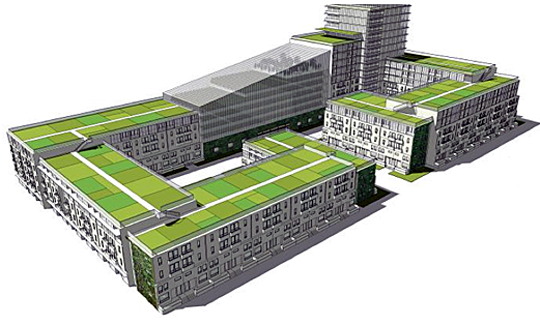
The concept of indoor farming is not new, since hothouse production of tomatoes, a wide variety of herbs, and other produce has been in vogue for some time. What is new is the urgent need to scale up this technology to accommodate another 3 billion people. An entirely new approach to indoor farming must be invented, employing cutting edge technologies. The Vertical Farm must be efficient (cheap to construct and safe to operate). Vertical farms, many stories high, will be situated in the heart of the world's urban centers. If successfully implemented, they offer the promise of urban renewal, sustainable production of a safe and varied food supply (year-round crop production), and the eventual repair of ecosystems that have been sacrificed for horizontal farming.

Vertical Farms' Advantages
  • Year-round crop production; 1 indoor acre is equivalent to 4-6 outdoor acres or more, depending upon the crop (e.g., strawberries: 1 indoor acre = 30 outdoor acres) 
  • No weather-related crop failures due to droughts, floods, pests 
  • All VF food is grown organically: no herbicides, pesticides, or fertilizers 
  • VF virtually eliminates agricultural runoff by recycling black water 
  • VF returns farmland to nature, restoring ecosystem functions and services 
  • VF greatly reduces the incidence of many infectious diseases that are acquired at the agricultural interface 
  • VF converts black and gray water into potable water by collecting the water of evapotranspiration 
  • VF adds energy back to the grid via methane generation from composting non-edible parts of plants and animals 
  • VF dramatically reduces fossil fuel use (no tractors, plows, shipping.) 
  • VF converts abandoned urban properties into food production centers 
  • VF creates sustainable environments for urban centers 
  • VF creates new employment opportunities 
  • We cannot go to the moon, Mars, or beyond without first learning to farm indoors on earth 
  • VF may prove to be useful for integrating into refugee camps 
  • VF offers the promise of measurable economic improvement for tropical and subtropical LDCs. If this should prove to be the case, then VF may be a catalyst in helping to reduce or even reverse the population growth of LDCs as they adopt urban agriculture as a strategy for sustainable food production. 
  • VF could reduce the incidence of armed conflict over natural resources, such as water and land for agriculture


Vertical Farms' Designs


Comment:
Farm Towers are nicely suited for Aquaponics system. The fish tanks would be located on the ground floor since it is where the sunlight is most deficient. The hydroponics will then occupy all the floors above it. Using minimal pumps, the water flow would be highly energy efficient since it travels back to the fish tank using gravity. In addition to that, the tower could also be energy independent if renewable energy sources such as wind and solar are tapped.

07 October 2012

Aquaponics Trial #2

Hey guys, its been a while.

Here's the second trial I've been doing at my house. Had the first prototype moved out of the shade plus additional 2 pods. Also added a fish tank i acquired from a fish store that's about to move out of town.


Actually these photos here are outdated by 2-3 months, since I've already started to harvest them from August. Anyway, here's a close-up of the pods.


I've been trying a lot of different kinds of vegetable; kailan, lettuce, salad, cabbage, sawi, etc. But the most success I've had so far is the kangkung (water spinach).


The two tanks shown are connected underneath; the right tank receives freshly filtered water from the pods. It has 9-10 lampam fish. The water then travel to the left tank (along with fish faeces), before being pumped to the highest pods to begin the cycle again.


11 June 2012

Aquaponics and Worms

Credit to Vermiaquaponics article by Great Lakes Aquaponics
http://greatlakesaquaponics.wikispaces.com/Vermiaquaponics

How to Breed Worms for Fishing thumbnail


Vermiaquaponics is actually a word my father and I invented. It is in laymans terms the same thing as aquaponics but with a combination of worm breeding. You use the worm castings to make a nutrient tea which is then used to feed the plants through their roots directly and in the form of foliar feeding. Foliar feeding is when you feed a plant through its leaves. You spray the tea onto the leaves directly and the goal is to have the nutrients be absorbed in more than one way. Then the worms themselves are used to feed the fish thus eliminating some of the cost of fish feed, and making these aquaponic systems more self sustainable.

Vermiaquaponics will soon become the future of aquaponics. In a way many people use certain aspects of it by feeding their plants with extra micronutrients and such.(for example chelated iron, manganese, zinc, etc) But what makes this version so unique is that it will help eliminate the cost of fish feed which becomes an enormous expense. In addition you are feeding your fish great protein which should theoretically help them to grow faster and bigger. Although worms do not give fish 100% of their diet, and are nearly 90% composed of water, so supplements will be required. So essentially your getting your fish wish less cost improving your profit. 


One concern I have about this new form of growing is when it gets to the commercial scale. Places like the University of the Virgin Islands are harvesting over 5 tons of fish annually and in order for something like this to be beneficial to them you would need a very vast number of worms. Making vermiaquaponics less practical on a commercial scale but definately beneficial on the hobby scale. Something to consider if trying to convert from aquaponics to vermiaquaponics is that you will need the space to grow your worms, and to make sure you will have enough worms to be able to integrate this technology into aquaponics.

The focus on vermiaquaponics is to not incorporate it in systems producing such high quantities of fish. For the Urban Farmer, primary focus should be on plant growth in order to make profit. Using as little fish as possible and supplementing with tea will reduce other costs. The key is to get the right number of fish to plant growth ratio and also adding the vermiaquaponics side of the equation. When all these numbers can be worked out maximum plant growth to cost can be achieved giving you maximum profit.

24 April 2012

Aquaponics Presentation #2


BALANCING AN AQUAPONICS SYSTEM

There are several items that needs balancing in an aquaponics system 

1. Nitrate level ~ high: Nitrogen-eating bacteria converts Ammonia to Nitrate

2. Water pH level ~ 7.0 optimum 
3. Sodium salts concentration ~ low 
4. Iron (Fe) addition 
5. Fish feed 
   

BENEFITS OF AN AQUAPONICS SYSTEM
 
There are a lot of benefits of managing an aquaponics system, such as:

1. Conservation through constant water reuse and recycling 
2. Organic fertilization of plants with natural fish emulsion 
3. The elimination of solid waste disposal from intensive aquaculture 


4. The reduction of needed cropland to produce vegetable crops 
5. The overall reduction of environmental footprint for crop production 
6. Small efficient commercial installations can be built close to markets therefore reducing food miles


7. Small systems are easily setup and operated; thus everybody can try 
8. If many people in our country starts their own small aquaponics system at home;
            a) sell surplus harvest, good side-income source 
            b) use fresh food daily, increase in overall health 


Besides all the benefits and profits, one should be aware of its disadvantages, such as:
1. Initial expense to start an aquaponic project
2.The infinite number of ways to configure
3. Rely heavily on energy, technology & control
4. Have multiple 'single points of failure' where problems can lead to
complete loss of fish stock


***presentation continues into #3, refer older post***